Is Baking Soda an Enzyme Cleaner? Fungal Alpha-Amylase Supplier Guide for Baking
Baking soda is not an enzyme. Compare it with fungal alpha-amylase for bread, cake, and flour treatment procurement.
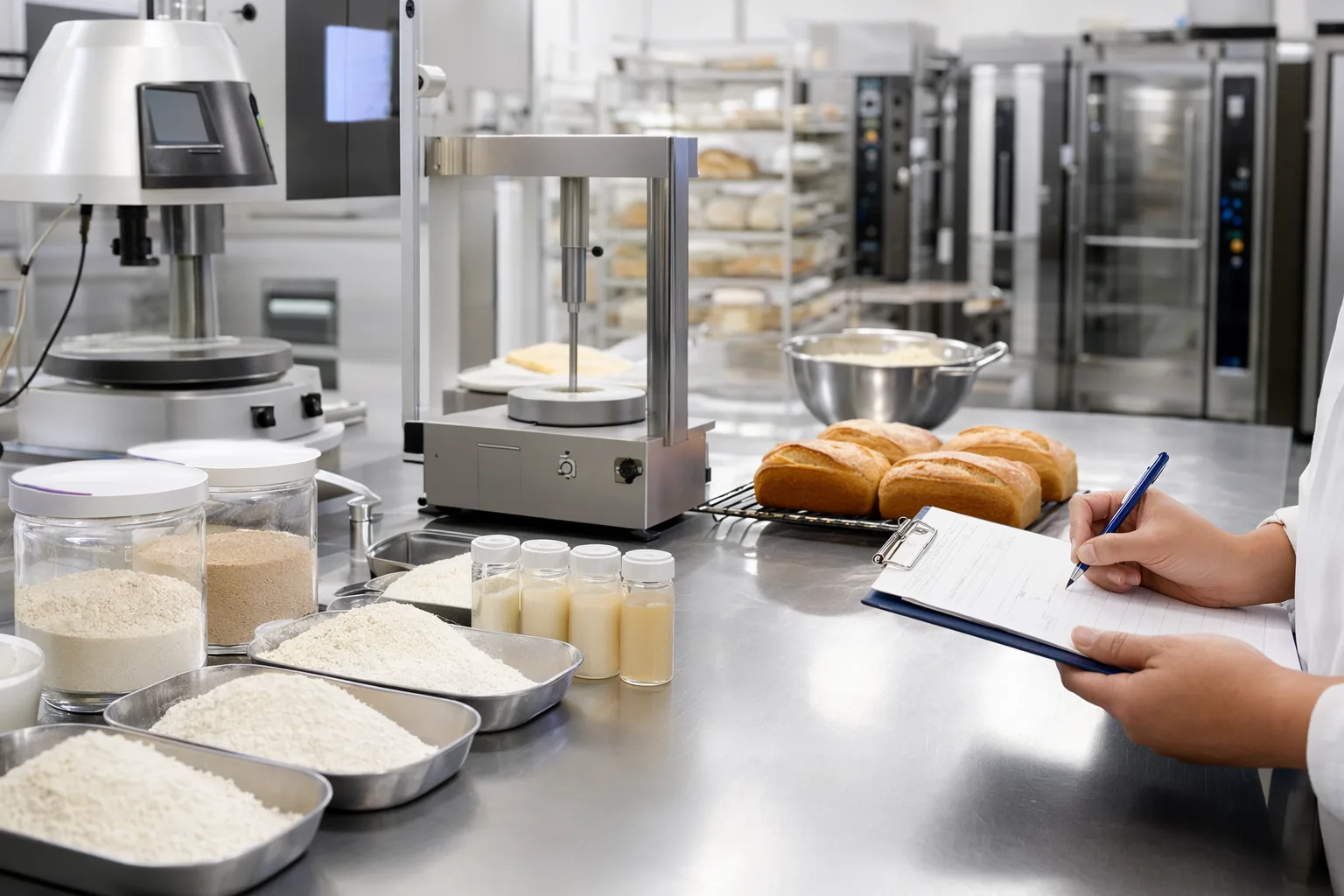
For industrial bakeries and flour mills, baking soda is a chemical leavening or pH modifier—not a baking enzyme. Here is how fungal alpha-amylase supports dough performance, crumb quality, and cost-in-use decisions.
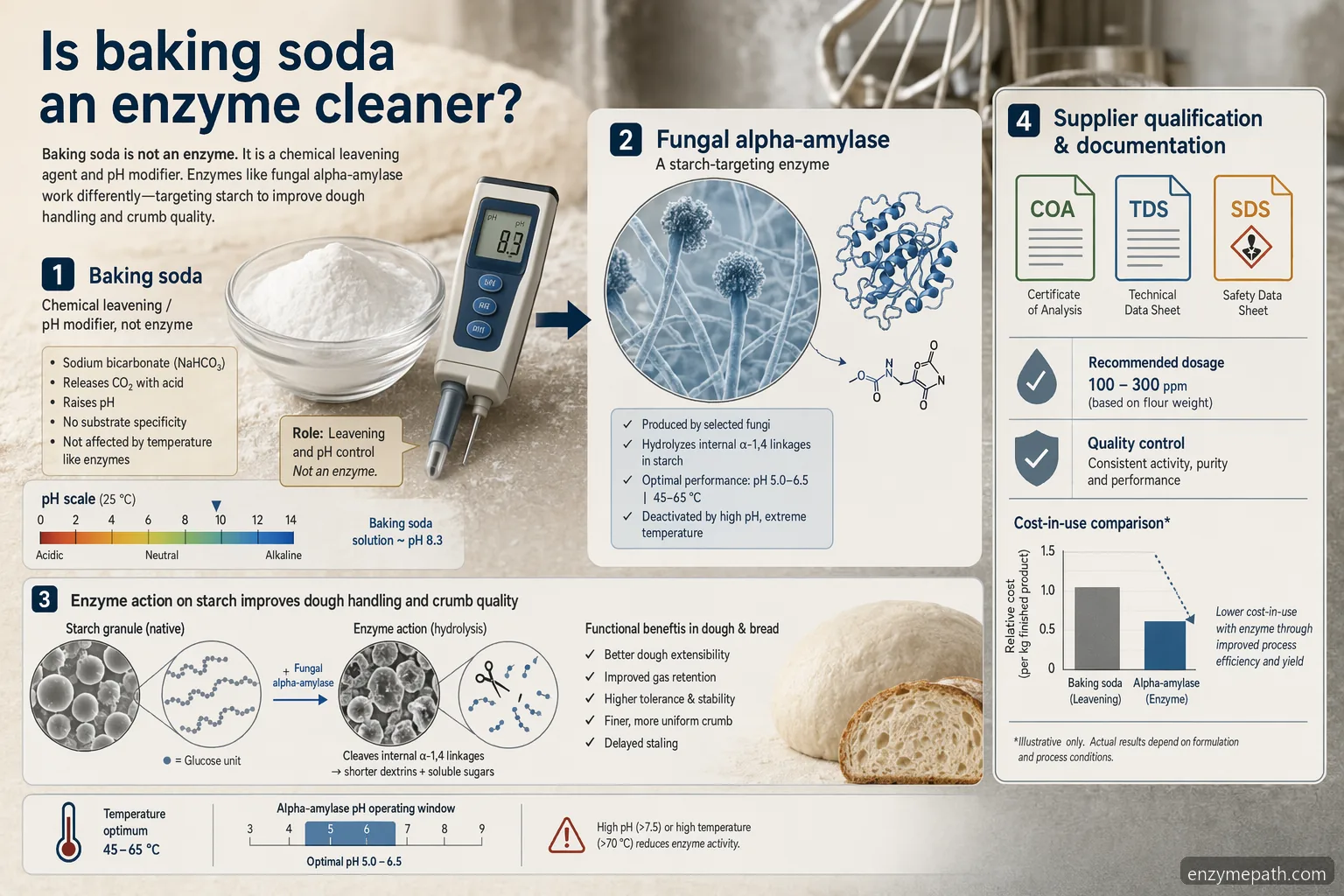
Baking Soda Is Not an Enzyme Cleaner
The question “is baking soda an enzyme cleaner” often appears in procurement research, but the technical answer is no. Baking soda is sodium bicarbonate, an alkaline salt that reacts with acids to release carbon dioxide. It can help with deodorizing, mild abrasion, and pH adjustment, but it does not contain catalytic proteins. Related searches such as “baking soda enzyme cleaner,” “is baking soda enzyme cleaner,” “is vinegar and baking soda an enzyme cleaner,” and “enzyme cleaner and baking soda” describe household cleaning mixtures, not industrial enzyme systems. In baking, sodium bicarbonate may be useful in chemically leavened cakes or biscuits, while fungal alpha-amylase performs a different function: it hydrolyzes damaged starch into fermentable sugars and dextrins. For B2B buyers, confusing these categories can lead to poor formulation choices, inconsistent dough performance, and inaccurate cost comparisons.
Baking soda: chemical leavening and pH effect • Fungal alpha-amylase: catalytic starch modification • Vinegar plus baking soda: acid-base reaction, not enzymatic cleaning
Where Fungal Alpha-Amylase Fits in the Baking Industry
Fungal alpha-amylase is a widely used bread enzyme for industrial bakeries, premix manufacturers, and flour treatment operations. It acts on damaged starch in flour, generating sugars that yeast can ferment and that contribute to crust color through Maillard browning. In straight dough, sponge dough, frozen dough, and some cake systems, the right dosage can improve loaf volume, crumb openness, handling tolerance, and day-to-day flour consistency. It is not a direct substitute for chemical leaveners, emulsifiers, oxidants, or dedicated anti-staling enzyme systems, but it can support softness and eating quality when balanced with the full improver formula. Enzymes in the baking industry are selected by substrate, activity, heat stability, and application target. For bread, cake, and flour treatment, buyers should evaluate fungal alpha-amylase against flour quality, process time, proofing conditions, and finished product specifications.
Bread: fermentation support, loaf volume, crust color • Cake: batter tolerance and crumb consistency where starch modification is useful • Flour treatment: correction of low amylase activity or high Falling Number
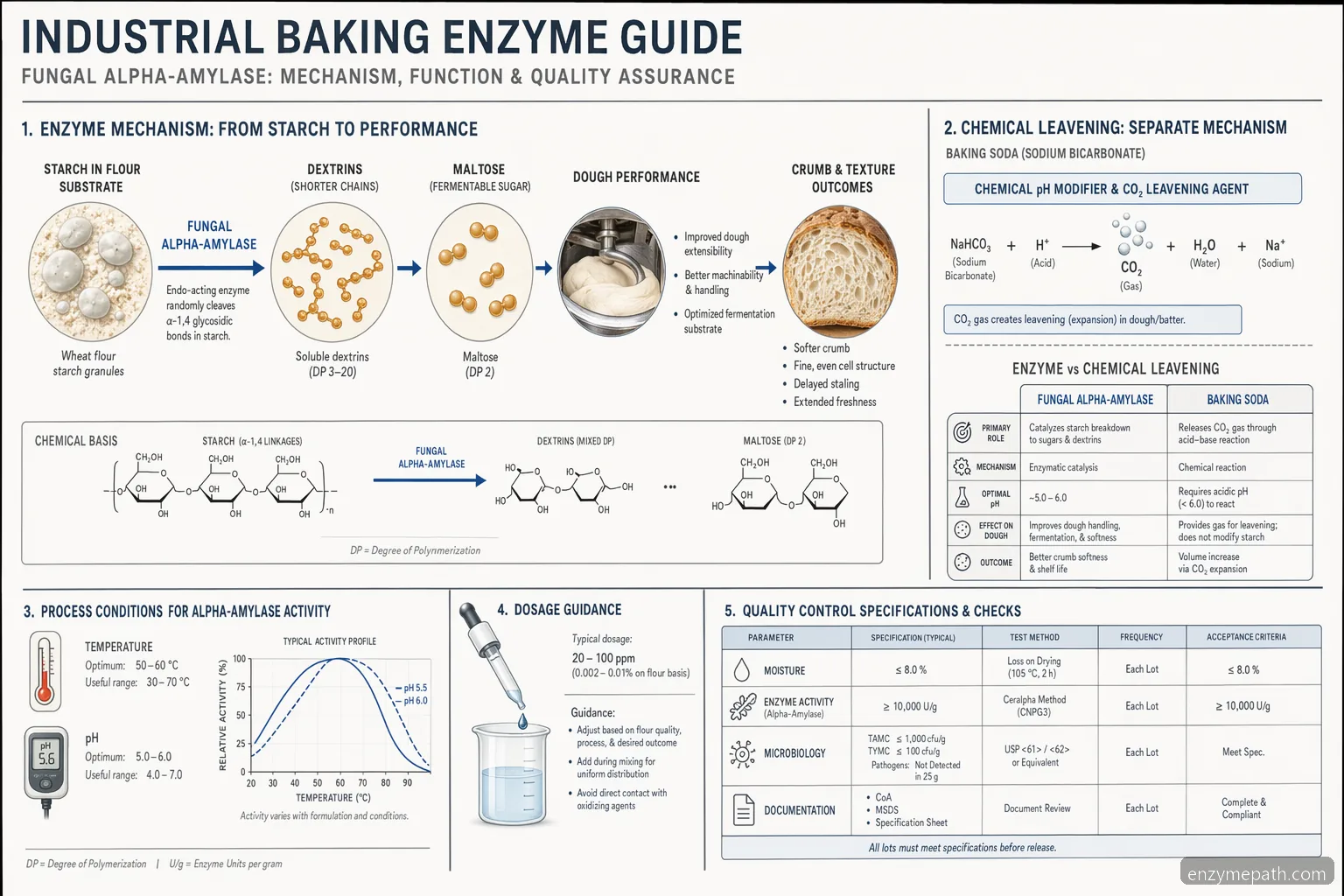
Recommended Process Conditions and Dosage Bands
Fungal alpha-amylase performance depends on enzyme activity units, flour quality, water absorption, pH, dough temperature, and residence time. Many bakery-grade fungal alpha-amylases show useful activity around pH 4.5–6.0, with strong activity near typical dough pH. Activity often increases with temperature up to approximately 45–55°C, then declines as the enzyme denatures during baking. In bread applications, starting trials commonly fall around 10–100 g per metric ton of flour, or the equivalent activity dosage recommended on the supplier TDS. Flour treatment may require tighter bands because over-dosing can create sticky dough, excessive dextrin formation, dark crust, or gummy crumb. Cake applications should be tested separately because sugar, fat, emulsifier, and batter pH can change enzyme response. Buyers should never transfer a dosage from one supplier to another without comparing declared activity and method.
Typical working pH: about 4.5–6.0 • Typical activity window: dough and early bake stages, roughly 30–60°C • Indicative dosage: often 10–100 g/ton flour, product dependent • Bake inactivation: confirm with supplier data and finished-product checks
Pilot Validation and Quality Control Checks
A robust pilot plan should compare the control flour system, current improver, and several fungal alpha-amylase dosage levels under actual plant conditions. For flour treatment, start with flour analytics such as moisture, protein, damaged starch, ash, Falling Number, and amylograph or RVA viscosity. For bakery trials, record mixing time, dough temperature, absorption, stickiness, proof height, proof time, oven spring, loaf volume, crust color, sliceability, and crumb structure. Finished-product checks should include crumb firmness on day 1, day 3, and day 5, plus sensory review and packaging compatibility. If the target is an anti-staling enzyme effect, compare fungal alpha-amylase against specialized anti-staling systems rather than assuming equivalent performance. A well-documented pilot helps procurement calculate cost-in-use and helps technical teams avoid under-dosing, over-dosing, or masking flour variability with excessive improver use.
Run control, low, mid, and high dosage trials • Track dough handling and finished-product texture • Measure loaf volume, crumb firmness, and shelf-life indicators • Confirm no gummy crumb or excessive crust darkening
Supplier Documentation: COA, TDS, and SDS
Before approving a fungal alpha-amylase supplier, request a current Certificate of Analysis, Technical Data Sheet, and Safety Data Sheet. The COA should identify batch number, activity result, activity method, appearance, microbiological limits where applicable, and release date. The TDS should clarify recommended applications, dosage range, carrier or formulation type, solubility or dispersibility, pH and temperature guidance, storage conditions, shelf life, and compatibility notes. The SDS should cover handling, dust control, respiratory sensitization precautions, spill response, and transport information. Avoid unverifiable claims and ask suppliers to explain any performance statement in terms of trial data, test method, or customer application. If your bakery uses allergen, halal, kosher, non-GMO, or regional regulatory programs, request only the documentation actually relevant to your market and audit requirements.
COA: batch-specific activity and release data • TDS: application, dosage, and process guidance • SDS: safe handling and occupational exposure information • Supplier questionnaire: quality system, traceability, and change control
Cost-in-Use and Commercial Qualification
The lowest enzyme price per kilogram is not always the lowest cost-in-use. Compare fungal alpha-amylase products by delivered activity, effective dosage per ton of flour, waste reduction, process stability, and finished-product acceptance. A concentrated liquid or powder may cost more per kilogram but require a lower dose, simplify inventory, or improve consistency. Commercial qualification should include sample evaluation, pilot bakery trials, plant-scale confirmation, shelf-life checks, and purchasing review. Also evaluate lead time, minimum order quantity, packaging size, storage temperature, lot traceability, and technical response time. Searches such as “is baking soda an enzyme,” “enzyme in baking soda,” or “enzyme solution with borax and baking soda” do not address these industrial criteria. For baking procurement, the relevant decision is whether a validated fungal alpha-amylase improves the formula at an acceptable cost per finished unit.
Compare cost per ton of flour treated, not only price per kilogram • Include freight, shelf life, dosage accuracy, and production losses • Approve suppliers through technical, quality, and purchasing review
Technical Buying Checklist
Buyer Questions
No. Baking soda is sodium bicarbonate, a chemical compound that can neutralize acids, release carbon dioxide in leavening systems, and provide mild abrasive cleaning action. It does not contain enzymes and does not catalyze starch, protein, or fat breakdown. In industrial baking, fungal alpha-amylase is the enzyme used for starch modification, while baking soda is used for chemical leavening or pH adjustment.
No. Vinegar and baking soda create an acid-base reaction that releases carbon dioxide, water, and salts. This reaction may loosen some soils by fizzing, but it is not enzymatic. A true enzyme system contains proteins such as amylase, protease, lipase, or cellulase. For baking applications, fungal alpha-amylase is selected for starch hydrolysis, not for cleaning.
Baking soda releases gas when it reacts with acids, mainly supporting chemical leavening in certain formulas. Fungal alpha-amylase catalyzes starch hydrolysis, producing fermentable sugars and dextrins that can support yeast activity, loaf volume, crust color, and crumb quality. The two materials are not interchangeable. Selection depends on whether the bakery needs leavening chemistry, starch modification, or both.
A practical screening range for many bakery-grade fungal alpha-amylase products is about 10–100 g per metric ton of flour, but the correct dose depends on enzyme activity units, flour Falling Number, damaged starch, formula, process time, and target product. Buyers should follow the supplier TDS, run pilot trials at multiple levels, and verify results through dough handling and finished-product QC checks.
Fungal alpha-amylase can contribute to crumb softness and eating quality by modifying starch, but it should not automatically be treated as equivalent to specialized anti-staling enzyme systems. For shelf-life targets, compare formulas using crumb firmness testing over several days, sensory review, and packaging trials. Supplier technical data and pilot validation should guide whether fungal alpha-amylase alone is sufficient.
Request a COA for batch-specific activity and release data, a TDS for dosage and process guidance, and an SDS for safe handling. Buyers should also ask for activity method, shelf-life and storage conditions, traceability information, change-control policy, and any regulatory or allergen documents required for the target market. Supplier qualification should include pilot support and plant-scale validation.
Fungal Alpha-Amylase (Baking Grade) for Research & Industry
Need Fungal Alpha-Amylase (Baking Grade) for your lab or production process?
ISO 9001 certified · Food-grade & research-grade · Ships to 80+ countries
Frequently Asked Questions
Is baking soda an enzyme cleaner?
No. Baking soda is sodium bicarbonate, a chemical compound that can neutralize acids, release carbon dioxide in leavening systems, and provide mild abrasive cleaning action. It does not contain enzymes and does not catalyze starch, protein, or fat breakdown. In industrial baking, fungal alpha-amylase is the enzyme used for starch modification, while baking soda is used for chemical leavening or pH adjustment.
Is vinegar and baking soda an enzyme cleaner?
No. Vinegar and baking soda create an acid-base reaction that releases carbon dioxide, water, and salts. This reaction may loosen some soils by fizzing, but it is not enzymatic. A true enzyme system contains proteins such as amylase, protease, lipase, or cellulase. For baking applications, fungal alpha-amylase is selected for starch hydrolysis, not for cleaning.
How is fungal alpha-amylase different from baking soda in bread?
Baking soda releases gas when it reacts with acids, mainly supporting chemical leavening in certain formulas. Fungal alpha-amylase catalyzes starch hydrolysis, producing fermentable sugars and dextrins that can support yeast activity, loaf volume, crust color, and crumb quality. The two materials are not interchangeable. Selection depends on whether the bakery needs leavening chemistry, starch modification, or both.
What dosage should an industrial bakery start with?
A practical screening range for many bakery-grade fungal alpha-amylase products is about 10–100 g per metric ton of flour, but the correct dose depends on enzyme activity units, flour Falling Number, damaged starch, formula, process time, and target product. Buyers should follow the supplier TDS, run pilot trials at multiple levels, and verify results through dough handling and finished-product QC checks.
Can fungal alpha-amylase be used as an anti-staling enzyme?
Fungal alpha-amylase can contribute to crumb softness and eating quality by modifying starch, but it should not automatically be treated as equivalent to specialized anti-staling enzyme systems. For shelf-life targets, compare formulas using crumb firmness testing over several days, sensory review, and packaging trials. Supplier technical data and pilot validation should guide whether fungal alpha-amylase alone is sufficient.
What documents should a buyer request from a baking enzyme supplier?
Request a COA for batch-specific activity and release data, a TDS for dosage and process guidance, and an SDS for safe handling. Buyers should also ask for activity method, shelf-life and storage conditions, traceability information, change-control policy, and any regulatory or allergen documents required for the target market. Supplier qualification should include pilot support and plant-scale validation.
Related: Fungal Alpha-Amylase for Baking Performance Control
Turn This Guide Into a Supplier Brief Request a fungal alpha-amylase sample, COA/TDS/SDS package, and pilot dosage support from EnzymePath for your bread, cake, or flour treatment project. See our application page for Fungal Alpha-Amylase for Baking Performance Control at /applications/baking-enzymes-market/ for specs, MOQ, and a free 50 g sample.
Contact Us to Contribute