Fungal Alpha-Amylase Baking Enzymes for Bread, Cake, and Flour Treatment
Process guide for fungal amylase baking applications: dosage, pH, temperature, QC, validation, and supplier qualification for industrial bakers.
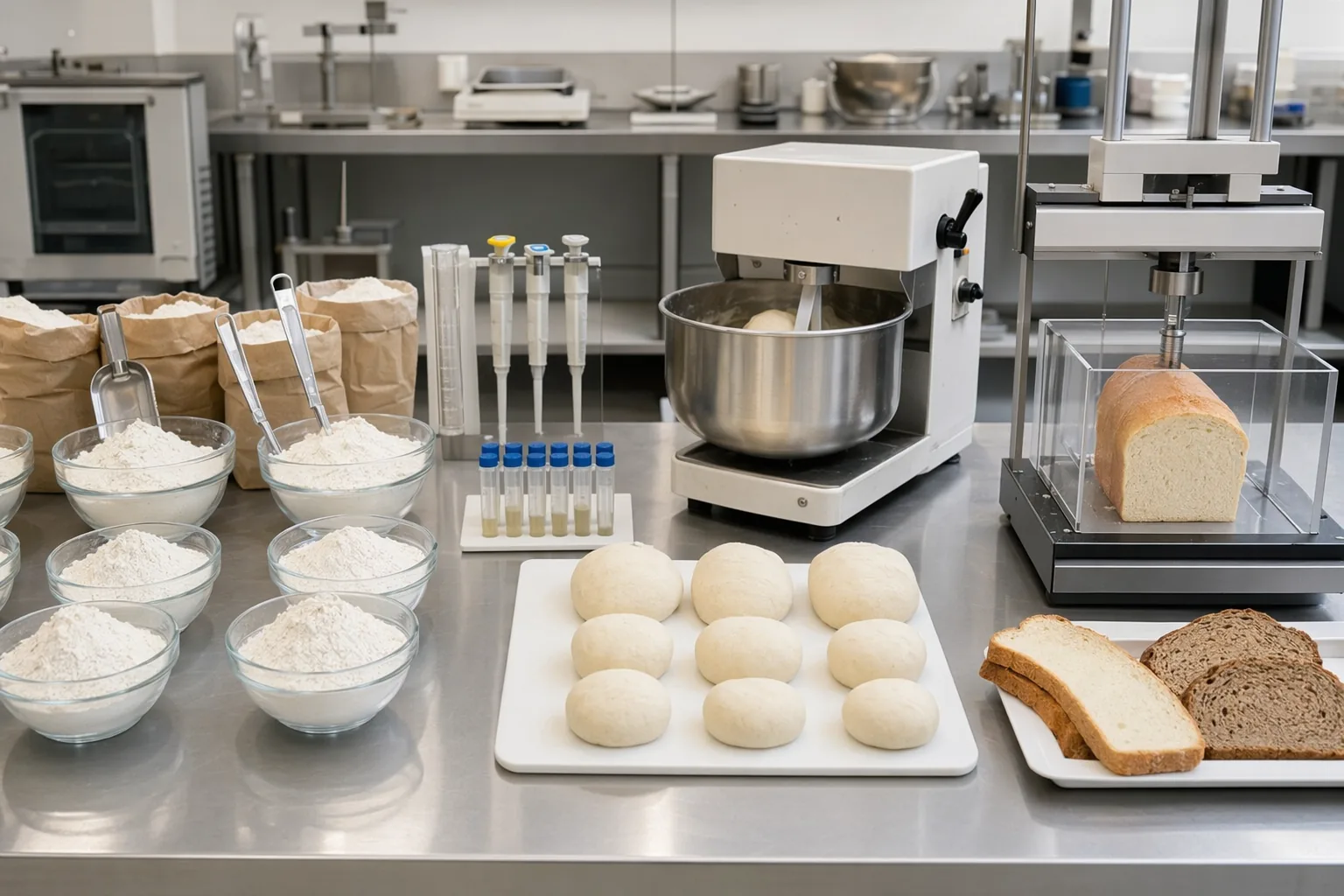
A practical B2B guide to using fungal alpha-amylase in baking processes to support dough fermentation, loaf volume, crust color, crumb texture, and consistent flour performance.
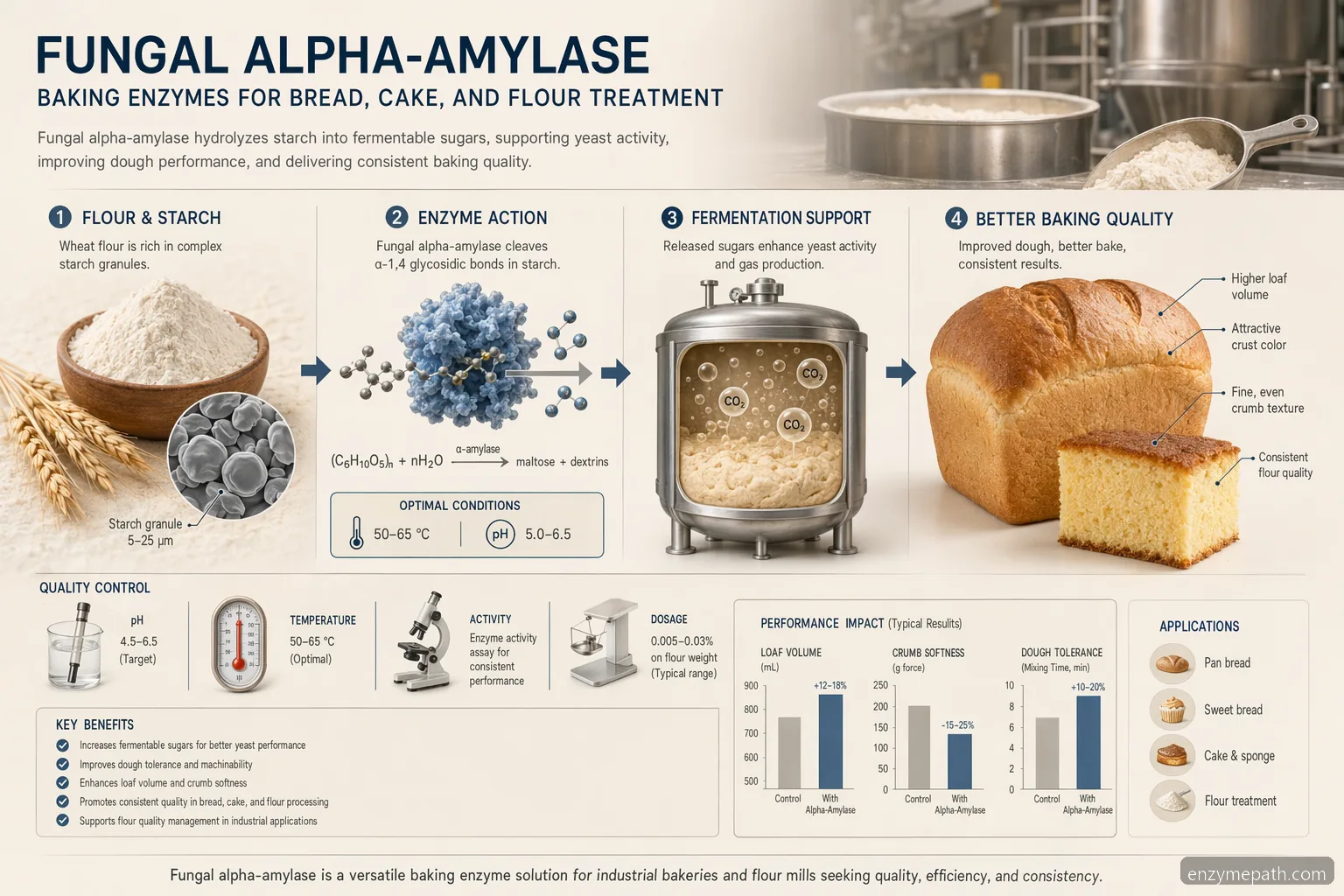
Why Fungal Alpha-Amylase Matters in Baking
Fungal alpha-amylase is one of the most established baking enzymes for bread, cake, and flour treatment. It hydrolyzes starch, especially damaged starch in flour, into smaller dextrins and fermentable sugars. In yeast-leavened doughs, this can support gas production, proofing consistency, crust browning, and loaf volume when the native flour enzyme level is too low. In cake and sweet baked goods, controlled starch modification may help texture and processing tolerance, depending on the formula. Unlike chemical leaveners, enzymes in baking act catalytically and are used at low inclusion rates, usually through premixes, flour improvers, or direct dosing. Fungal alpha-amylase is not a universal anti-staling enzyme, but it can contribute to crumb softness when correctly balanced with other baking industry enzymes. Overuse may cause sticky dough, gummy crumb, excessive crust color, or slicing issues, so dosage validation is essential.
Primary function: starch hydrolysis for fermentable sugar release • Common formats: powder, granulate, or liquid enzyme preparation • Best fit: bread, buns, rolls, cakes, and flour correction systems • Risk of overdose: gummy crumb, tackiness, and excess browning
Recommended Process Conditions and Dosage Approach
For fungal amylase baking systems, practical performance is usually strongest in mildly acidic dough conditions. Many commercial fungal alpha-amylases operate well around pH 4.5–6.0, with activity commonly observed in the 30–60°C range and reduced activity as baking temperatures rise. Thermal inactivation typically occurs during baking as crumb temperature increases, but the exact profile depends on enzyme source, formulation, water activity, and dough matrix. Industrial dosage is activity-dependent and should follow the supplier TDS; initial screening often starts around 5–50 ppm on flour weight for concentrated products, or at the activity units recommended by the supplier. High-speed bakeries should test across flour lots, proof times, and fermentation stress conditions. The right dosage is not the highest dosage; it is the minimum level that delivers consistent dough performance, crumb quality, and cost-in-use without creating stickiness or shelf-life defects.
Typical dough pH target: about 4.5–6.0, formula dependent • Typical activity window: about 30–60°C before thermal inactivation • Screening band: often 5–50 ppm flour basis for concentrated products • Always normalize by declared enzyme activity, not only weight
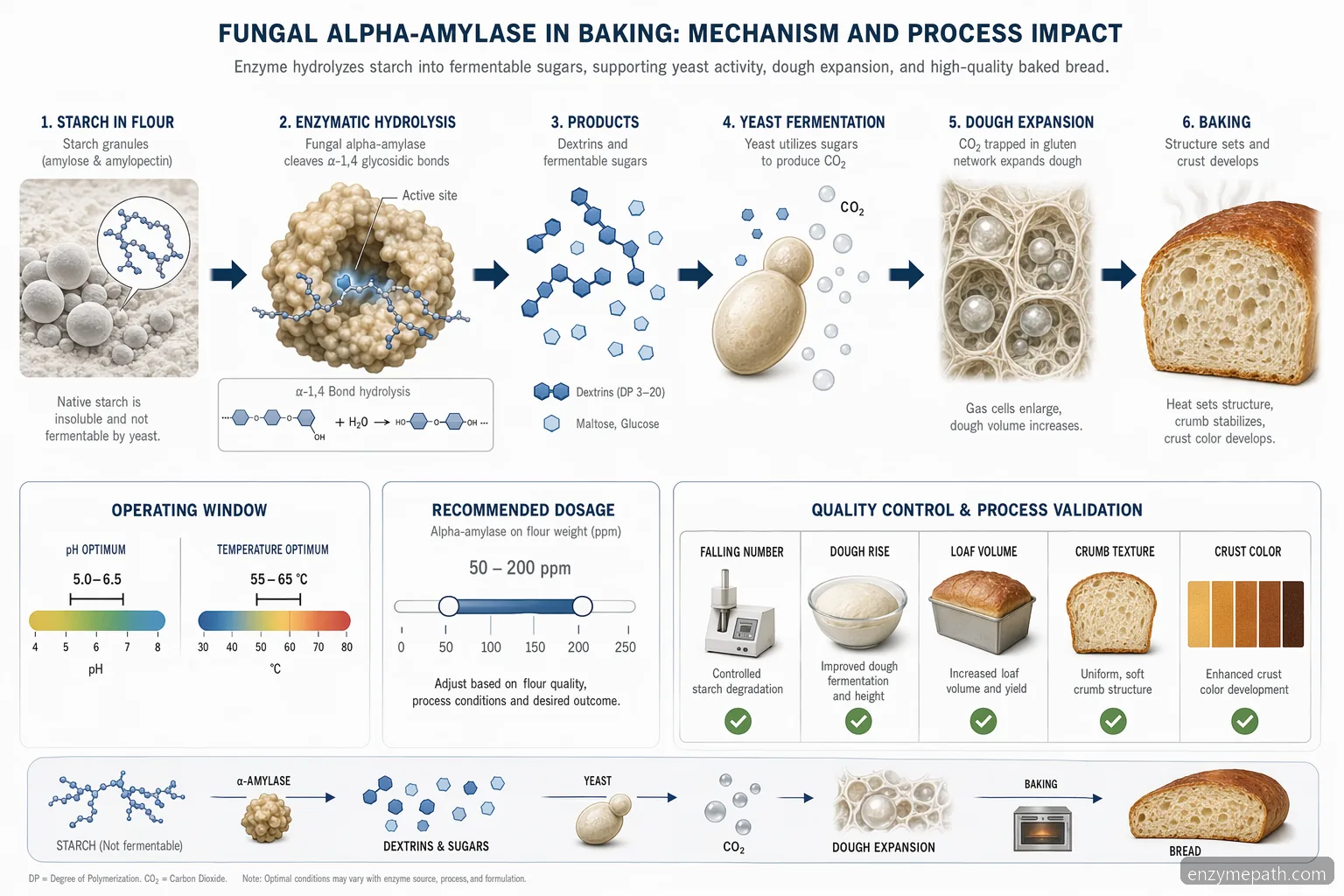
How Are Enzymes Used in Baking Operations?
How are enzymes used in baking? In industrial plants, enzymes for baking are normally dosed through flour improvers, dry premixes, liquid dosing systems, or flour mill treatment programs. Fungal alpha-amylase should be dispersed uniformly because low-dose ingredients can create batch-to-batch variation if blending is poor. In bread, the enzyme is commonly added during mixing, then acts through dough development, fermentation, proofing, and early oven spring. In flour treatment, it may be used to correct low endogenous amylase activity, often guided by falling number or amylograph data. For cakes, dosage must be tested carefully because high sugar, fat, emulsifier, and water levels change enzyme access to starch. If used with xylanase, glucose oxidase, lipase, protease, or maltogenic amylase, run factorial trials because enzyme interactions can be positive or negative depending on flour and formula.
Dose through premix, improver, liquid system, or mill treatment • Validate blending uniformity for low-dose enzyme preparations • Adjust for flour damage, absorption, fermentation time, and sugar level • Test interactions with other baking enzymes before scale-up
QC Checks for Pilot Validation and Scale-Up
A reliable baking enzyme program should be validated before full production. Start with a control flour and at least three enzyme levels: below target, target, and above target. Useful flour and dough checks include falling number, amylograph or RVA viscosity profile, damaged starch, farinograph absorption, extensograph or alveograph strength, dough temperature, pH, and proof height. Finished product checks should include loaf volume, specific volume, crumb structure, crust color, sliceability, crumb firmness over time, water activity, and sensory review. For anti-staling evaluation, use objective crumb firmness or texture analyzer data over the intended shelf-life, not only day-one softness. Monitor plant risks such as flour lot changes, delayed dough, warm proofing, and line stoppages. Scale-up should confirm that the chosen enzyme dose performs under actual mixer energy, dough size, proofing humidity, oven profile, and packaging timing.
Run control, low, target, and high dose pilot bakes • Use falling number and viscosity testing to characterize flour • Measure loaf volume, crumb firmness, color, and sliceability • Confirm performance under real plant delays and oven conditions
Supplier Qualification and Cost-in-Use
For B2B procurement, selecting baking enzymes is not only a price-per-kilogram decision. Buyers should compare declared activity, activity test method, recommended dosage, carrier system, shelf life, storage conditions, dusting profile, solubility, and compatibility with existing improvers. Request a current COA for each lot, plus TDS and SDS before plant trials. Depending on market requirements, also review food-grade suitability, country-specific regulatory status, allergen statements, GMO status, vegetarian or vegan suitability if relevant, and traceability documentation. Cost-in-use should be calculated on flour treated or finished product output, not purchase price alone. A higher-activity enzyme may reduce dose, handling, freight, and inventory cost. Supplier qualification should include sample consistency, technical support, complaint response, lead time, packaging integrity, and ability to provide pilot guidance without making unsupported performance guarantees.
Request COA, TDS, SDS, and activity method before approval • Compare cost per metric ton of flour treated • Check storage, shelf life, carrier, and handling requirements • Qualify suppliers through pilot performance and documentation review
Technical Buying Checklist
Buyer Questions
Common enzymes in baking include fungal alpha-amylase, maltogenic amylase, xylanase, lipase, glucose oxidase, protease, and sometimes cellulase or hemicellulase blends. Each has a different role. Alpha-amylase mainly supports starch conversion and fermentation, while xylanase affects dough handling, lipase can support crumb structure, and maltogenic amylase is more specifically associated with softness retention in many anti-staling systems.
Industrial bakers usually add enzymes through a flour improver, bakery premix, or direct micro-dosing system. Label treatment depends on the market, formulation, and whether the enzyme is considered a processing aid or must be declared. Because rules vary by country and product type, buyers should confirm regulatory and labeling requirements with qualified internal or external regulatory specialists before commercial launch.
No. Baking soda, or sodium bicarbonate, is a chemical leavening agent, not an enzyme and not an enzyme cleaner. It releases carbon dioxide when combined with acid and moisture or heat, helping batters rise. Baking enzymes are proteins that catalyze reactions such as starch, protein, or fiber modification. They are used at much lower levels and require different handling and validation.
Fungal alpha-amylase may contribute to softer crumb when properly dosed, but it is not the same as a dedicated anti-staling enzyme system. Maltogenic amylase and selected blends are often used when shelf-life softness is the primary target. If anti-staling performance is required, validate with texture analyzer data, sensory panels, and storage trials over the intended shelf-life, not only fresh-bake measurements.
Compare enzyme offers by activity, recommended dose, performance in your formula, documentation, storage stability, supplier support, and cost-in-use. A low price per kilogram can be misleading if the activity is lower or the dose is higher. Request COA, TDS, SDS, and pilot samples, then run controlled plant trials using your flour, process conditions, packaging, and shelf-life targets.
Fungal Alpha-Amylase (Baking Grade) for Research & Industry
Need Fungal Alpha-Amylase (Baking Grade) for your lab or production process?
ISO 9001 certified · Food-grade & research-grade · Ships to 80+ countries
Frequently Asked Questions
What enzymes are used in baking besides fungal alpha-amylase?
Common enzymes in baking include fungal alpha-amylase, maltogenic amylase, xylanase, lipase, glucose oxidase, protease, and sometimes cellulase or hemicellulase blends. Each has a different role. Alpha-amylase mainly supports starch conversion and fermentation, while xylanase affects dough handling, lipase can support crumb structure, and maltogenic amylase is more specifically associated with softness retention in many anti-staling systems.
How are enzymes used in baking without changing the label too much?
Industrial bakers usually add enzymes through a flour improver, bakery premix, or direct micro-dosing system. Label treatment depends on the market, formulation, and whether the enzyme is considered a processing aid or must be declared. Because rules vary by country and product type, buyers should confirm regulatory and labeling requirements with qualified internal or external regulatory specialists before commercial launch.
Is baking soda an enzyme cleaner or a baking enzyme?
No. Baking soda, or sodium bicarbonate, is a chemical leavening agent, not an enzyme and not an enzyme cleaner. It releases carbon dioxide when combined with acid and moisture or heat, helping batters rise. Baking enzymes are proteins that catalyze reactions such as starch, protein, or fiber modification. They are used at much lower levels and require different handling and validation.
Can fungal alpha-amylase be used as an anti-staling enzyme?
Fungal alpha-amylase may contribute to softer crumb when properly dosed, but it is not the same as a dedicated anti-staling enzyme system. Maltogenic amylase and selected blends are often used when shelf-life softness is the primary target. If anti-staling performance is required, validate with texture analyzer data, sensory panels, and storage trials over the intended shelf-life, not only fresh-bake measurements.
How should a bakery compare offers in the baking enzymes market?
Compare enzyme offers by activity, recommended dose, performance in your formula, documentation, storage stability, supplier support, and cost-in-use. A low price per kilogram can be misleading if the activity is lower or the dose is higher. Request COA, TDS, SDS, and pilot samples, then run controlled plant trials using your flour, process conditions, packaging, and shelf-life targets.
Related: Fungal Alpha-Amylase for Baking Performance Control
Turn This Guide Into a Supplier Brief Request a fungal alpha-amylase baking trial sample, TDS review, and cost-in-use evaluation for your flour and process. See our application page for Fungal Alpha-Amylase for Baking Performance Control at /applications/baking-enzymes-market/ for specs, MOQ, and a free 50 g sample.
Contact Us to Contributehello@mail.enzymepath.com