Alpha-Amylase Baking Enzyme Market: Process Guide
B2B guide to fungal alpha-amylase for baking: dosage, pH, temperature, QC, COA/TDS/SDS review, pilot trials, and supplier qualification.
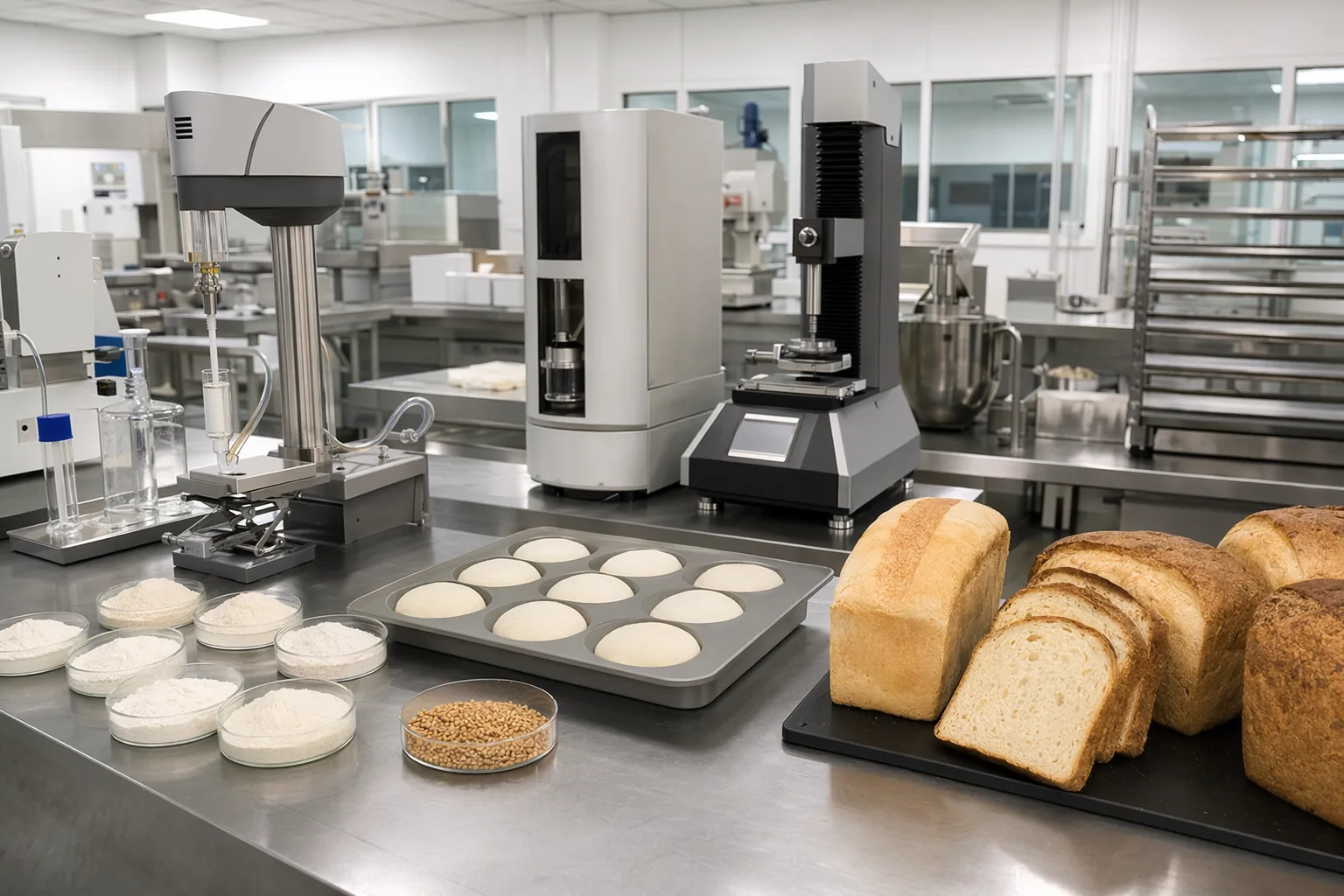
For industrial bakeries and flour mills, fungal alpha-amylase is a practical bread enzyme for improving fermentation support, dough handling, loaf volume, crumb texture, and shelf-life performance when validated under plant conditions.
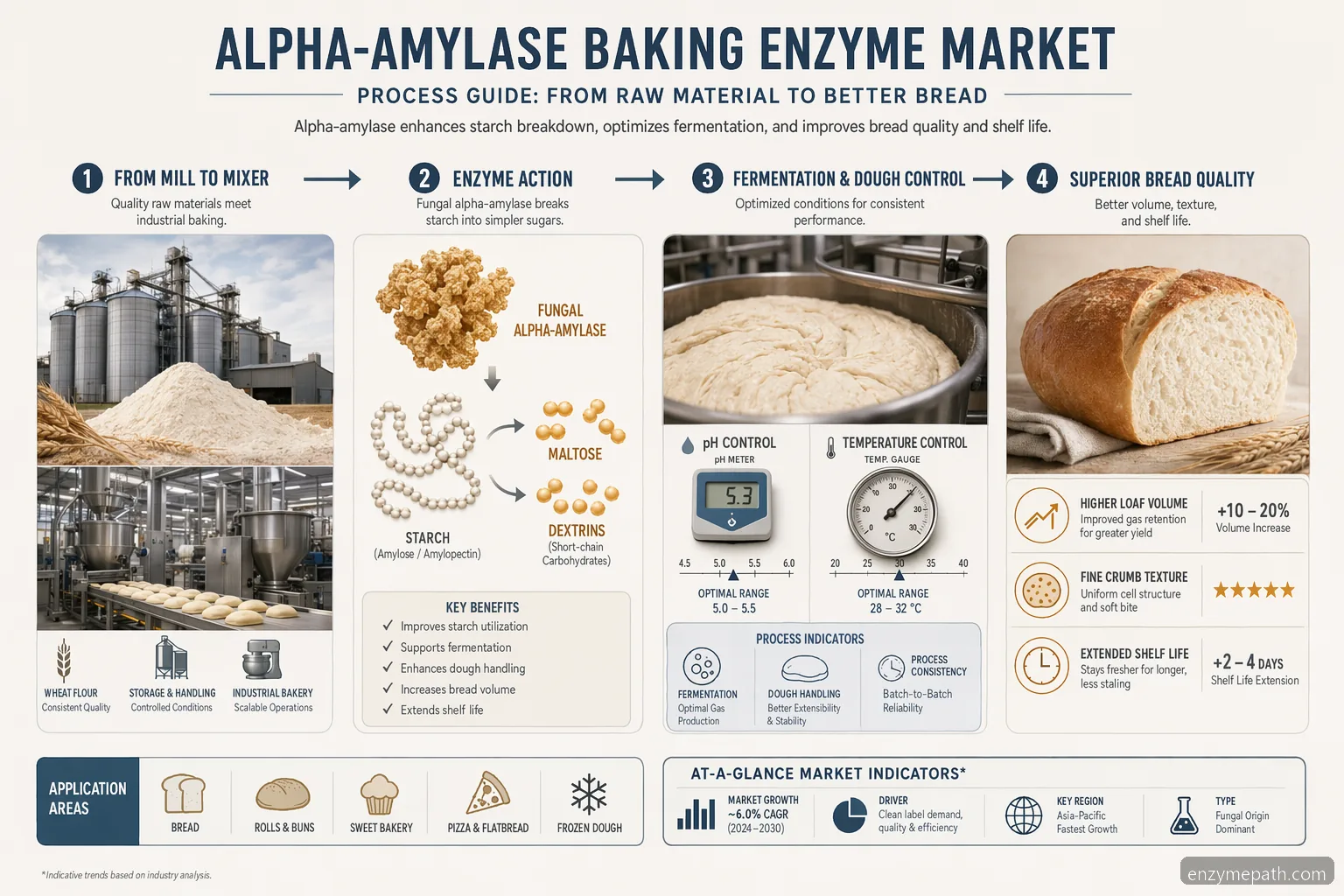
Market Context for Industrial Baking Buyers
The alpha-amylase baking enzyme market is driven by bakeries, premix manufacturers, and flour mills seeking consistent dough performance across variable wheat lots. In the enzymes baking industry, fungal alpha-amylase is valued because it hydrolyzes damaged starch into fermentable sugars and dextrins during mixing, fermentation, and early baking. This can support yeast activity, crust color, oven spring, crumb softness, and anti-staling performance when the dosage is controlled. The baking enzyme market is not a one-size-fits-all category: activity units, side activities, carrier type, granulation, and formulation compatibility can vary significantly by supplier. Industrial buyers should evaluate the enzyme as a process aid or ingredient according to local labeling requirements and the finished product specification. A practical procurement decision should combine technical baking data, plant trials, documentation review, and total cost-in-use rather than comparing price per kilogram alone.
Relevant for bread, buns, rolls, cake systems, and flour standardization • Commonly used with oxidants, emulsifiers, xylanase, lipase, or glucose oxidase where permitted • Best selected by performance per flour type and production process
How Alpha Amylase Enzyme in Baking Works
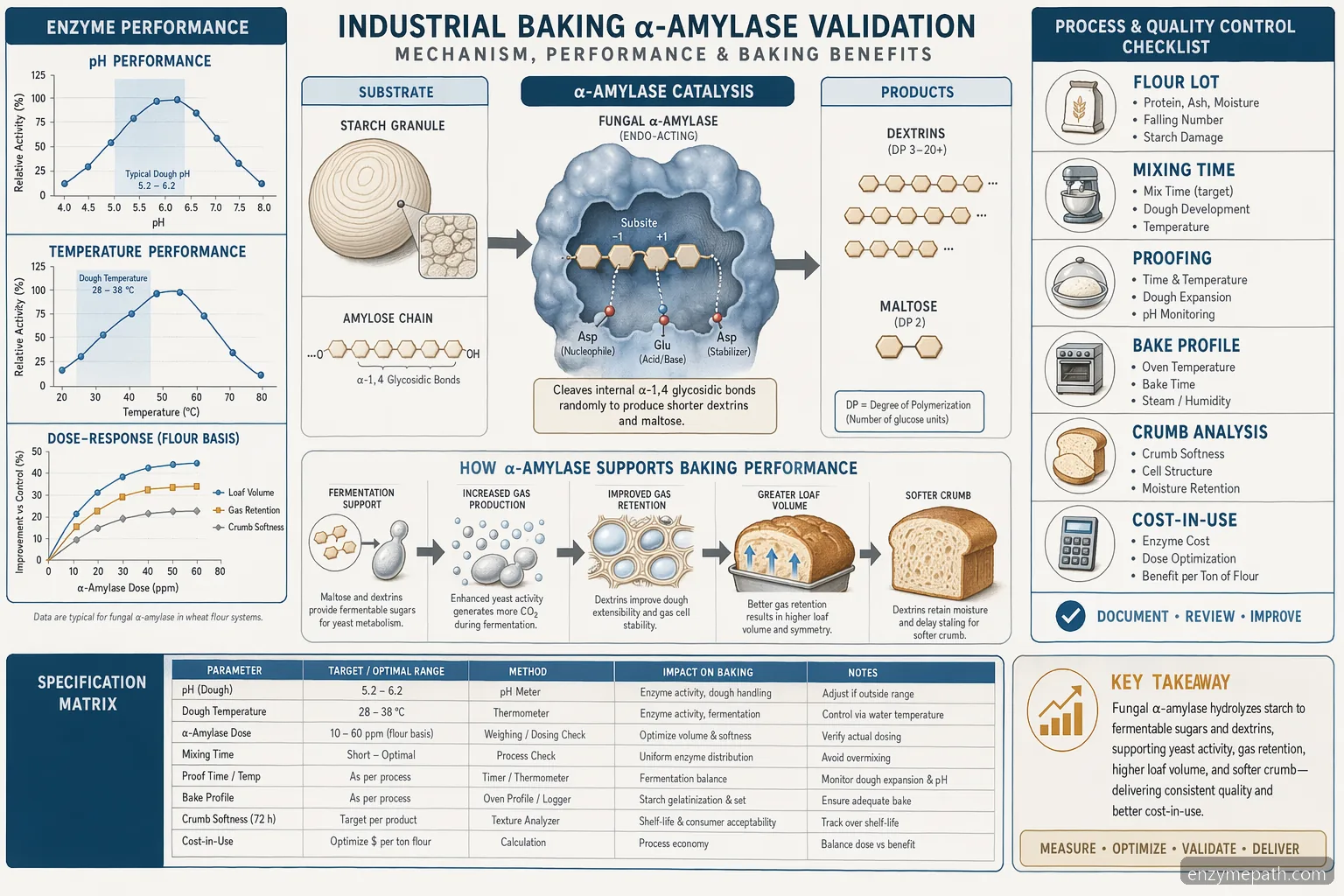
Alpha amylase enzyme in baking acts on starch, especially damaged starch generated during milling, by cleaving internal alpha-1,4 glycosidic bonds. In dough, this releases shorter dextrins and maltose-forming substrates that can improve fermentation support and influence crumb properties. Fungal alpha-amylase is generally favored for baking because its activity profile is compatible with dough conditions and it is substantially reduced during baking heat exposure, depending on formula, product size, and oven profile. Typical functional ranges are around pH 4.5 to 6.0 and about 35 to 60°C during dough processing and early bake stages, but buyers should rely on the supplier TDS for the exact activity curve. Over-treatment may create sticky dough, gummy crumb, excessive crust color, or poor slicing. Under-treatment may show limited volume or faster firming, particularly with low-damaged-starch flour.
Primary substrate: damaged starch in wheat flour • Main outputs: dextrins and fermentable sugar precursors • Risk of overdose: gummy crumb or sticky processing
How to Use Amylase Enzyme in Baking Trials
For how to use amylase enzyme in baking, start with the supplier’s activity declaration and dosage recommendation rather than a fixed weight percentage. Common industrial screening bands may range from approximately 5 to 50 ppm on flour weight for concentrated products, or about 1 to 10 g per 100 kg flour for some commercial blends; actual use depends on activity units and carrier dilution. Add the enzyme through a premix, flour treatment system, or controlled micro-ingredient feeder to avoid local hot spots. Run a control, low, medium, and high dosage trial using the same flour lot, water absorption, mixing energy, fermentation time, proof temperature, and oven profile. Record dough stickiness, proof height, oven spring, internal temperature, crumb cell structure, sliceability, and texture over shelf life. Scale up only after confirming that the selected level remains robust across normal flour variation.
Use activity-based dosage, not only grams per batch • Keep process variables constant during screening • Confirm performance in pilot and production-scale runs • Document operator observations and analytical results
Process Conditions, Quality Control, and Troubleshooting
A reliable amylase enzyme baking program should connect process conditions with objective QC checks. For flour treatment, measure Falling Number, damaged starch, moisture, protein, ash, and farinograph or mixograph behavior where available. For bakery validation, monitor dough temperature, pH, proof time, oven entry height, bake temperature, bake loss, loaf volume, crumb grain, water activity, and crumb firmness over the intended shelf life. Fungal alpha-amylase is usually active in dough pH ranges found in yeast-leavened products, but formulas containing acids, high sugar, high fat, preservatives, or whole grain inclusions may shift performance. If bread shows gummy crumb or collapse, reduce dosage, check flour Falling Number, review bake-out, and confirm uniform distribution. If there is little response, verify enzyme activity, storage conditions, addition point, process temperature, and whether flour starch damage is sufficient for the target reaction.
Useful QC tools: Falling Number, RVA or amylograph, texture analyzer, loaf volume • Control storage humidity and temperature according to SDS/TDS • Retain trial samples for shelf-life comparison
Supplier Qualification and Cost-in-Use
Industrial buyers evaluating the alpha amylase baking enzyme market should request a current COA, TDS, SDS, allergen statement, country of origin where needed, activity assay method, shelf-life data, recommended storage conditions, and lot traceability information. The COA should match the lot supplied and include activity or potency, appearance, microbiological limits where relevant, and any agreed specification parameters. The TDS should provide pH and temperature guidance, dosage range, application notes, and compatibility cautions. Supplier qualification should also consider batch-to-batch consistency, technical support, sample availability, lead time, packaging format, and change-control communication. Cost-in-use should be calculated by activity delivered per metric ton of flour and by measurable bakery outcomes such as scrap reduction, shelf-life target achievement, or formula simplification. Final approval should be based on pilot validation and production confirmation, not solely desk review.
Request COA, TDS, SDS, and lot traceability before approval • Compare cost per treated flour ton, not only price per kilogram • Confirm supplier support for troubleshooting and scale-up
Technical Buying Checklist
Buyer Questions
Fungal amylase baking applications focus on controlled starch breakdown in dough. The enzyme helps generate fermentable sugar precursors and dextrins from damaged starch, which can support fermentation, crust color, loaf volume, crumb softness, and anti-staling targets. Results depend on flour quality, formula, processing time, dosage, and baking conditions, so industrial bakeries should validate performance through structured pilot trials.
Choose an amylase enzyme for baking by comparing activity units, recommended dosage, pH and temperature profile, carrier system, documentation, and pilot performance. Request COA, TDS, SDS, allergen information, and lot traceability. Then test multiple dosages against a control using the same flour lot and process settings. The best option is usually the one with consistent results and the lowest validated cost-in-use.
No. Baking soda is sodium bicarbonate, a chemical leavening ingredient, not an enzyme cleaner and not a baking enzyme. It releases carbon dioxide when combined with acid and moisture. Alpha-amylase is a protein catalyst that acts on starch under suitable dough conditions. In B2B formulation work, baking soda and fungal alpha-amylase serve different functions and are evaluated with different specifications.
Dosage varies because alpha-amylase products differ in activity concentration and formulation. As a starting point, industrial trials may screen approximately 5 to 50 ppm on flour weight for concentrated enzymes, or supplier-recommended equivalents for diluted blends. Always dose by declared activity and confirm with pilot baking. Excessive dosage can cause sticky dough, gummy crumb, or too much browning.
Before purchasing a bread enzyme, request a lot-specific COA, technical data sheet, safety data sheet, activity assay method, allergen statement, storage and handling instructions, shelf-life information, and traceability details. For supplier qualification, also review packaging options, lead time, change-control practices, sample support, and technical service capability. Documentation should be checked alongside bakery trial results.
Fungal Alpha-Amylase (Baking Grade) for Research & Industry
Need Fungal Alpha-Amylase (Baking Grade) for your lab or production process?
ISO 9001 certified · Food-grade & research-grade · Ships to 80+ countries
Frequently Asked Questions
What is fungal amylase baking used for in industrial bread?
Fungal amylase baking applications focus on controlled starch breakdown in dough. The enzyme helps generate fermentable sugar precursors and dextrins from damaged starch, which can support fermentation, crust color, loaf volume, crumb softness, and anti-staling targets. Results depend on flour quality, formula, processing time, dosage, and baking conditions, so industrial bakeries should validate performance through structured pilot trials.
How should a bakery choose an amylase enzyme for baking?
Choose an amylase enzyme for baking by comparing activity units, recommended dosage, pH and temperature profile, carrier system, documentation, and pilot performance. Request COA, TDS, SDS, allergen information, and lot traceability. Then test multiple dosages against a control using the same flour lot and process settings. The best option is usually the one with consistent results and the lowest validated cost-in-use.
Is baking soda an enzyme cleaner or a baking enzyme?
No. Baking soda is sodium bicarbonate, a chemical leavening ingredient, not an enzyme cleaner and not a baking enzyme. It releases carbon dioxide when combined with acid and moisture. Alpha-amylase is a protein catalyst that acts on starch under suitable dough conditions. In B2B formulation work, baking soda and fungal alpha-amylase serve different functions and are evaluated with different specifications.
What dosage is typical for alpha amylase baking enzyme market products?
Dosage varies because alpha-amylase products differ in activity concentration and formulation. As a starting point, industrial trials may screen approximately 5 to 50 ppm on flour weight for concentrated enzymes, or supplier-recommended equivalents for diluted blends. Always dose by declared activity and confirm with pilot baking. Excessive dosage can cause sticky dough, gummy crumb, or too much browning.
What documents should buyers request before purchasing a bread enzyme?
Before purchasing a bread enzyme, request a lot-specific COA, technical data sheet, safety data sheet, activity assay method, allergen statement, storage and handling instructions, shelf-life information, and traceability details. For supplier qualification, also review packaging options, lead time, change-control practices, sample support, and technical service capability. Documentation should be checked alongside bakery trial results.
Related: Fungal Alpha-Amylase for Baking Performance Control
Turn This Guide Into a Supplier Brief Request a fungal alpha-amylase baking enzyme sample, COA/TDS/SDS review, and pilot trial guidance for your flour or bakery process. See our application page for Fungal Alpha-Amylase for Baking Performance Control at /applications/baking-enzymes-market/ for specs, MOQ, and a free 50 g sample.
Contact Us to Contributehello@mail.enzymepath.com