Baking Enzyme Market: How to Use Fungal Alpha-Amylase in Baking Formulations
Formulation guide for fungal alpha-amylase in bread, cake, and flour treatment, with dosage, process conditions, QC, and supplier checks.
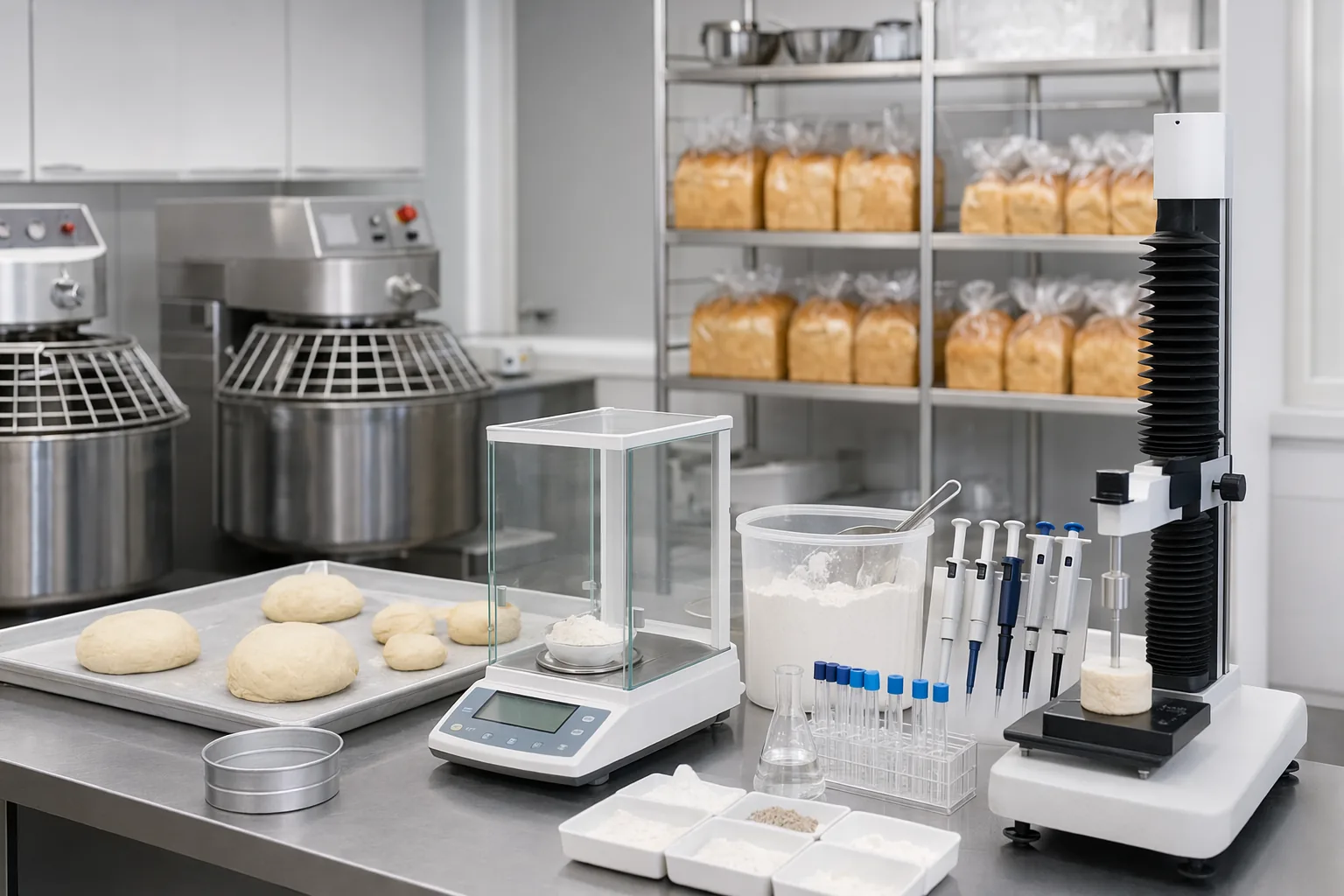
A practical B2B formulation guide for bakeries, premix manufacturers, and flour mills evaluating fungal alpha-amylase as a bread enzyme, cake improver, and flour treatment tool.
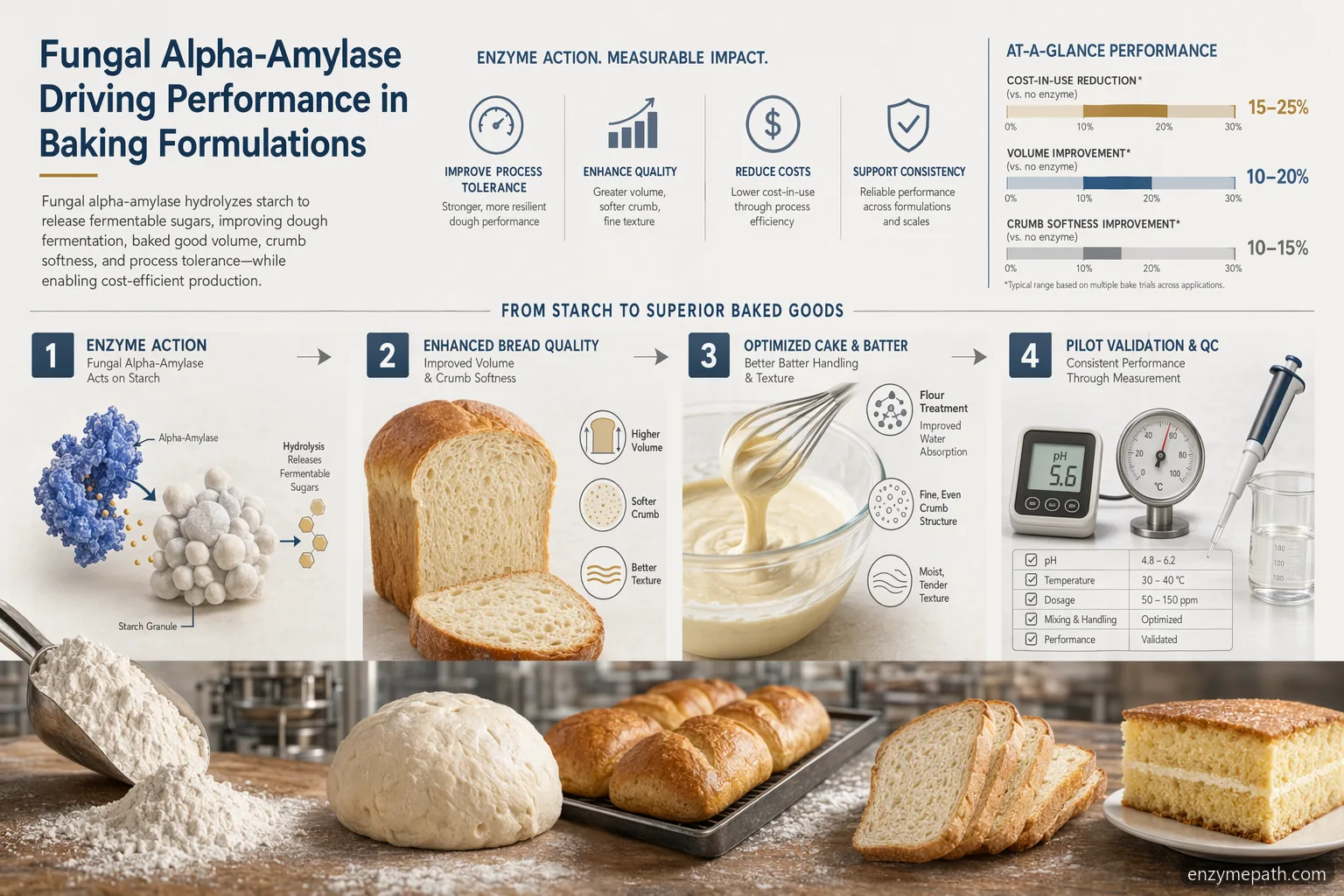
Why Fungal Alpha-Amylase Matters in the Baking Enzyme Market
The baking enzyme market is driven by processors that need consistent dough performance despite variable flour quality, shorter production windows, and demand for softer finished goods. Fungal alpha-amylase is one of the core baking enzymes because it converts damaged starch into fermentable sugars and small dextrins during mixing, fermentation, and early baking. In bread, this can support yeast activity, loaf volume, crust color, and eating softness. In cake and flour treatment, it is typically used at lower, controlled levels to balance batter viscosity, crumb tenderness, and processing tolerance. For industrial buyers, the key question is not whether an enzyme works in general, but whether the specific activity profile, carrier system, and dosage economics fit the line. A good formulation review compares enzyme activity units, flour ash and falling number, proof time, bake profile, and finished-product shelf-life targets before approving routine use.
Relevant to bread, cake, buns, rolls, and flour treatment systems. • Best evaluated as cost-in-use, not only price per kilogram. • Works alongside oxidants, emulsifiers, and other baking enzymes when validated.
Functional Role in Bread, Cake, and Flour Treatment
Fungal alpha-amylase acts mainly on starch, creating maltose and dextrins that affect dough fermentation and crumb structure. In bread, moderate activity can improve gas production, oven spring, crust color, and perceived freshness. In soft rolls and pan bread, it may contribute to anti-staling performance by modifying starch retrogradation, although results depend on recipe, water absorption, and storage conditions. In cake, the enzyme must be dosed carefully because excessive starch breakdown can weaken structure or create a tacky bite. In flour treatment, millers and premix suppliers use it to normalize performance where native amylase activity is too low. This is different from chemical leavening: questions like “is baking soda an enzyme” or “is baking soda an enzyme cleaner” confuse chemistry with biocatalysis. Baking soda is sodium bicarbonate, not an enzyme, and it does not provide the starch-specific action of alpha-amylase.
Primary substrate: damaged and gelatinizing starch. • Main benefits: fermentation support, volume, color, softness, and consistency. • Risk of excess: sticky dough, gummy crumb, or poor slicing.
Starting Dosage and Process Conditions
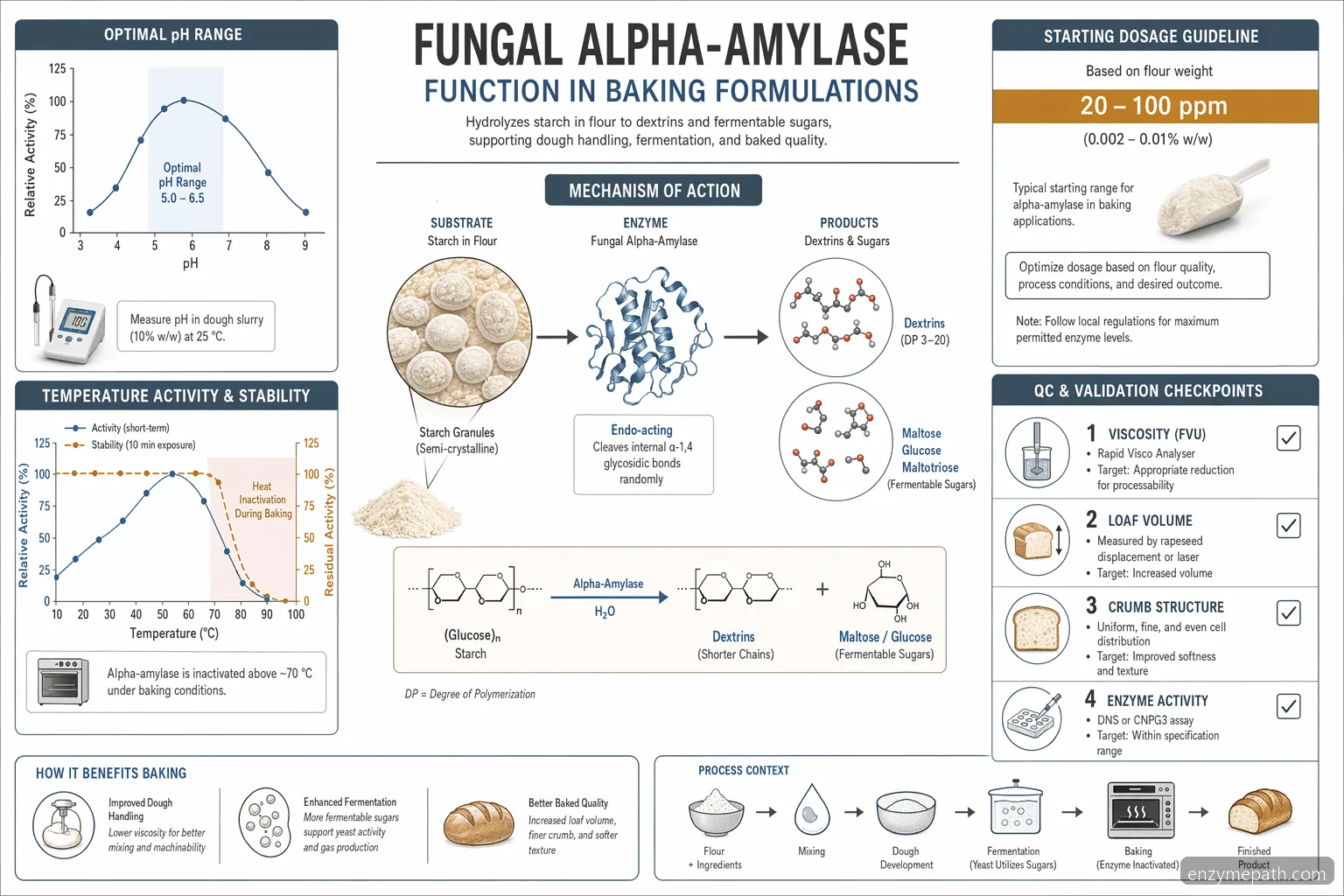
Dosage must be based on the supplier’s declared activity, but a common screening range for fungal amylase baking trials is about 20 to 200 g per metric ton of flour, or roughly 10 to 100 ppm of a concentrated enzyme preparation on flour weight. Some high-activity products require lower addition, so the TDS should always override generic ranges. Fungal alpha-amylase commonly performs in mildly acidic to near-neutral dough systems, with useful activity around pH 4.5 to 6.0. Activity rises through mixing, fermentation, and early baking, often showing strong performance around 45 to 60°C, then declining as heat inactivates the protein. In most baked goods, substantial inactivation occurs as internal product temperature climbs above about 80 to 90°C. For accurate addition, dilute powder premixes thoroughly or meter liquids into water to avoid hot spots and uneven crumb.
Begin with a low, mid, and high pilot dosage. • Track dough stickiness, proof height, bake color, and crumb gumminess. • Confirm thermal inactivation in the actual product and bake profile.
Pilot Validation and QC Checks
Before adopting an enzyme for baking market applications, run a structured pilot that reflects plant reality rather than bench convenience. Use the production flour, water temperature, mixer energy, fermentation time, divider stress, proofer humidity, and oven settings expected on the line. Record flour moisture, damaged starch, ash, protein, and falling number, because these variables influence alpha-amylase response. Finished-product checks should include loaf or cake volume, crumb cell uniformity, sliceability, crust color, water activity, texture profile, and sensory notes at day 0 and during storage. A simple anti-staling enzyme screen should compare firmness over the intended shelf life against the existing improver system. QC should also verify enzyme dispersion in premixes, batch-to-batch activity from COA data, and any interaction with preservatives, acids, emulsifiers, oxidants, gluten, or hydrocolloids used in the formulation.
Use control, current formulation, and proposed enzyme system. • Measure both process handling and finished-product quality. • Do not approve based only on one successful bake test.
Supplier Qualification, Documentation, and Cost-in-Use
Industrial buyers in the alpha amylase baking enzyme market should qualify both the enzyme and the supplier. Request a current COA for each lot, a TDS with activity definition and recommended handling, an SDS for workplace safety, and statements covering composition, carrier, allergen considerations, origin, and storage life. Avoid relying on unverifiable claims or generic “premium” language without data. Compare suppliers by activity consistency, technical support, sample availability, lead time, packaging compatibility, and responsiveness during troubleshooting. Cost-in-use should include the effective dose per metric ton of flour, any reduction in other improver components, waste reduction from better consistency, and possible shelf-life gains validated in your product. Because enzymes baking industry formulations are sensitive to small changes, supplier changes should trigger side-by-side pilot testing before scale-up or substitution in commercial premixes.
Request COA, TDS, SDS, and batch traceability documents. • Check storage guidance, dust control, and liquid or powder handling needs. • Calculate delivered performance per ton of flour, not only unit price.
Technical Buying Checklist
Buyer Questions
Fungal alpha-amylase breaks down damaged starch into fermentable sugars and dextrins during dough processing and early baking. This can support yeast activity, loaf volume, crust color, and crumb softness. In cake or flour treatment, it is used more cautiously to manage viscosity and tenderness. The correct effect depends on enzyme activity, flour quality, dosage, process time, and bake profile.
Start with the supplier’s TDS, then run low, medium, and high dosage trials on a flour-weight basis. A common screening band is about 20-200 g per metric ton of flour, but high-activity products may require less. Evaluate handling, proof response, volume, color, crumb gumminess, firmness during storage, and cost-in-use before approving a production dosage.
No. Baking soda is sodium bicarbonate, a chemical leavening or pH-adjusting ingredient, not a protein catalyst. It does not have the starch-specific activity of alpha-amylase. Searches such as “is baking soda an enzyme” or “is baking soda an enzyme cleaner” often mix household cleaning language with baking science. In industrial baking, enzymes and chemical leaveners perform different formulation roles.
For any enzyme for baking market use, request a COA for the lot, a TDS with activity definition and dosage guidance, an SDS for safe handling, and composition or carrier information. Buyers should also ask for allergen and origin statements, shelf-life and storage guidance, lot traceability, and technical support for pilot trials. Avoid supplier approval based only on generic marketing claims.
Alpha-amylase may help reduce crumb firming by modifying starch during baking and storage, but it is not a universal fix. The anti-staling result depends on flour, water absorption, fat, emulsifiers, bake loss, packaging, and storage temperature. Validate with texture measurements over the target shelf life. Overdosing can create gumminess, so softness gains must be balanced with sliceability and eating quality.
Fungal Alpha-Amylase (Baking Grade) for Research & Industry
Need Fungal Alpha-Amylase (Baking Grade) for your lab or production process?
ISO 9001 certified · Food-grade & research-grade · Ships to 80+ countries
Frequently Asked Questions
What does fungal alpha-amylase do in baking formulations?
Fungal alpha-amylase breaks down damaged starch into fermentable sugars and dextrins during dough processing and early baking. This can support yeast activity, loaf volume, crust color, and crumb softness. In cake or flour treatment, it is used more cautiously to manage viscosity and tenderness. The correct effect depends on enzyme activity, flour quality, dosage, process time, and bake profile.
How should a bakery set dosage for fungal amylase baking trials?
Start with the supplier’s TDS, then run low, medium, and high dosage trials on a flour-weight basis. A common screening band is about 20-200 g per metric ton of flour, but high-activity products may require less. Evaluate handling, proof response, volume, color, crumb gumminess, firmness during storage, and cost-in-use before approving a production dosage.
Is baking soda an enzyme or an enzyme cleaner?
No. Baking soda is sodium bicarbonate, a chemical leavening or pH-adjusting ingredient, not a protein catalyst. It does not have the starch-specific activity of alpha-amylase. Searches such as “is baking soda an enzyme” or “is baking soda an enzyme cleaner” often mix household cleaning language with baking science. In industrial baking, enzymes and chemical leaveners perform different formulation roles.
What documents should buyers request before purchasing baking enzymes?
For any enzyme for baking market use, request a COA for the lot, a TDS with activity definition and dosage guidance, an SDS for safe handling, and composition or carrier information. Buyers should also ask for allergen and origin statements, shelf-life and storage guidance, lot traceability, and technical support for pilot trials. Avoid supplier approval based only on generic marketing claims.
How is alpha-amylase used as an anti-staling enzyme?
Alpha-amylase may help reduce crumb firming by modifying starch during baking and storage, but it is not a universal fix. The anti-staling result depends on flour, water absorption, fat, emulsifiers, bake loss, packaging, and storage temperature. Validate with texture measurements over the target shelf life. Overdosing can create gumminess, so softness gains must be balanced with sliceability and eating quality.
Related: Fungal Alpha-Amylase for Baking Performance Control
Turn This Guide Into a Supplier Brief Contact EnzymePath to request fungal alpha-amylase samples, documentation, and pilot-scale formulation support for your baking line. See our application page for Fungal Alpha-Amylase for Baking Performance Control at /applications/baking-enzymes-market/ for specs, MOQ, and a free 50 g sample.
Contact Us to Contribute