Enzymes Baking Industry: Fungal Alpha-Amylase Specification Checklist for Baking
Compare fungal alpha-amylase for baking: specs, dosage, pH, temperature, COA/TDS/SDS, QC, pilot trials, and cost-in-use.
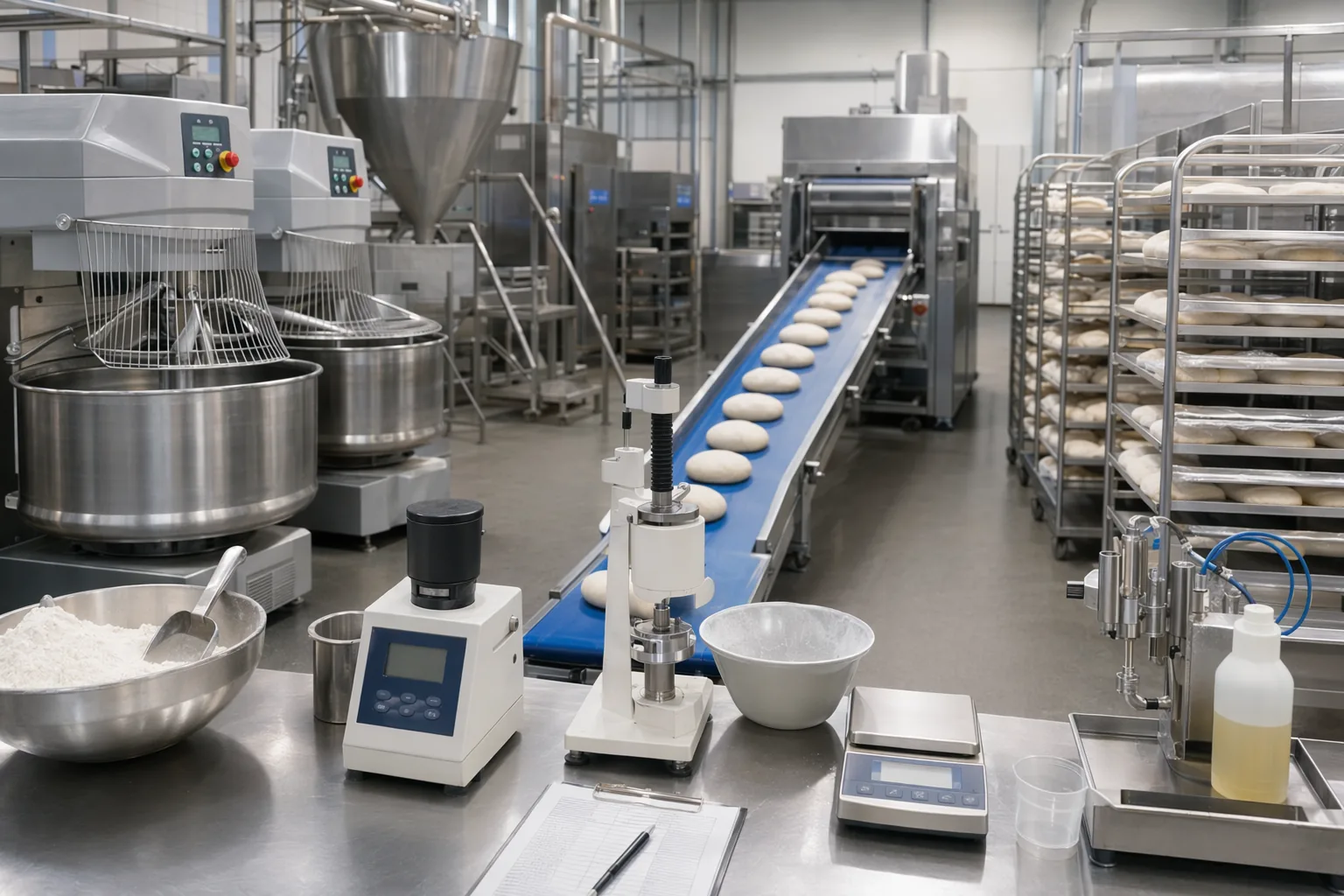
A practical buyer’s guide for comparing fungal alpha-amylase as a baking enzyme for bread, cake, and flour treatment applications.
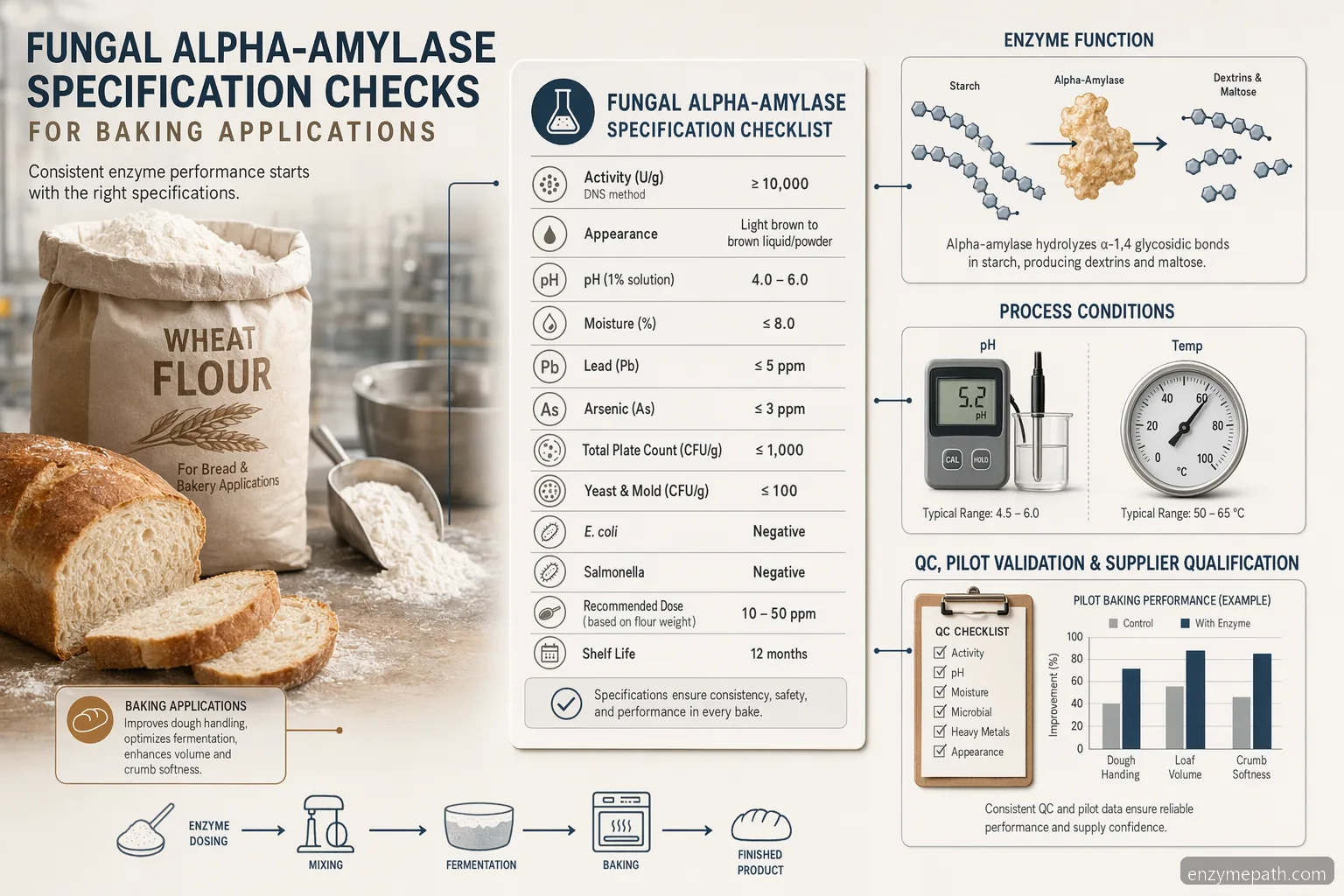
Why Fungal Alpha-Amylase Matters in Baking Industry Enzymes
In the enzymes baking industry, fungal alpha-amylase is one of the core amylolytic tools used to standardize flour and improve dough fermentation performance. It hydrolyzes damaged starch into smaller dextrins and fermentable sugars, giving yeast more substrate and supporting gas production, oven spring, crust browning, and crumb softness. For bread plants, cake premix manufacturers, and flour mills, the commercial value is not the enzyme name alone; it is repeatable performance across flour lots, process times, and finished product targets. Compared with chemical flour treatment alone, baking enzymes can offer more controlled functionality at low inclusion rates. However, enzyme performance depends on flour damage, formula sugar, fermentation time, dough temperature, pH, and thermal inactivation during baking. A purchasing checklist should therefore connect the specification sheet to plant conditions, not just quote activity units or price per kilogram.
Common use areas: pan bread, buns, rolls, cakes, and flour correction. • Main performance targets: fermentation support, volume, color, crumb texture, and consistency. • Key risk of overdosing: sticky dough, gummy crumb, or excessive dextrin formation.
Comparison: Fungal Amylase vs Other Bread Enzyme Options
Fungal alpha-amylase should be compared with the wider set of enzymes used in baking industry applications. Bacterial alpha-amylase may have higher heat stability and can create more residual activity if not controlled, which may increase gumminess risk in some breads. Maltogenic amylase is more directly associated with crumb firming control and is often selected as an anti-staling enzyme for packaged bread. Xylanase targets arabinoxylans to improve dough handling and volume, while protease relaxes gluten for crackers, biscuits, or machinability. Glucose oxidase can strengthen dough through oxidative effects, and lipase may help emulsification and crumb structure. Fungal alpha-amylase is often chosen when the main need is fermentable sugar generation and flour performance correction, not when the target is only long shelf-life softness. The best commercial choice may be a single enzyme or a blended baking enzyme system validated against the plant’s own formula.
Fungal alpha-amylase: fermentation support and flour correction. • Maltogenic amylase: stronger fit for anti-staling targets. • Xylanase: dough handling, volume, and water management. • Protease: dough relaxation for selected bakery formats.
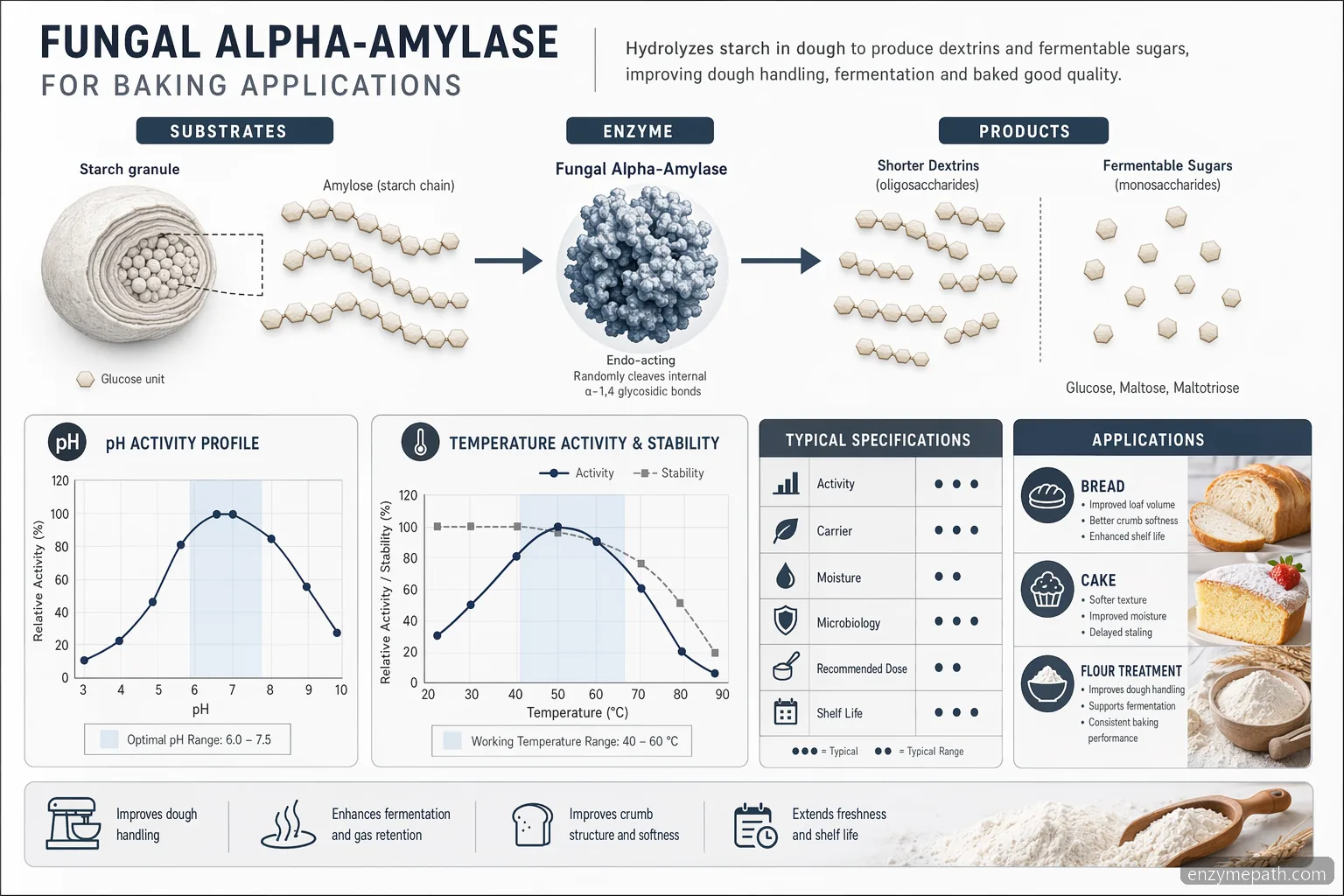
Process Conditions to Verify Before Purchase
Before approving a fungal alpha-amylase for baking, align supplier data with real plant conditions. Many fungal alpha-amylases used in baking show useful activity around mildly acidic to near-neutral dough pH, commonly near pH 4.5 to 6.0, with activity increasing during warm mixing, fermentation, proofing, and early baking stages. Practical dough temperatures may be 24 to 32°C, while the enzyme’s laboratory optimum may be higher, often around 45 to 60°C depending on source and assay. Thermal inactivation typically occurs as crumb temperature rises during baking, but exact behavior depends on moisture, formula, enzyme type, and time-temperature exposure. Dosage must be expressed against declared activity and flour weight, not copied from another supplier’s product. Many plants begin pilot screening in a low ppm or g/metric ton flour range, then refine by bake response and defect limits.
Check application pH against dough, batter, or flour system. • Compare laboratory optimum temperature with actual proof and bake profile. • Confirm inactivation behavior to reduce gummy crumb risk. • Set dosage by activity units and bake results, not only by product weight.
Specification Checklist for B2B Enzyme Buyers
A strong supplier comparison should include technical, quality, regulatory, logistics, and commercial details. Ask for a current COA, TDS, and SDS for each fungal alpha-amylase candidate. The COA should report enzyme activity using a defined method, lot number, date, appearance, and relevant quality checks. The TDS should state application guidance, dosage basis, storage conditions, shelf life, pH and temperature information, carrier or diluent, solubility or dispersibility, and handling precautions. The SDS should describe safe industrial handling, dust control, allergen sensitization risk, personal protective equipment, and spill response. Buyers should also check whether the product format fits the plant, such as powder, granulate, or liquid. Supplier qualification should cover manufacturing consistency, change notification, traceability, lead time, packaging integrity, and technical support for pilot validation.
Request COA, TDS, and SDS before plant trials. • Confirm the assay method behind the declared activity units. • Review carrier, dusting tendency, dispersibility, and storage stability. • Evaluate traceability, lead time, and change-control practices.
Pilot Validation and QC Checks
Pilot validation converts an enzymes used in baking industry PDF or enzymes in baking industry PPT into measurable plant evidence. Start with a control formula, then test at least three enzyme levels around the supplier’s recommended dosage. For flour treatment, common QC inputs include moisture, protein, ash, damaged starch, falling number, and farinograph or extensograph behavior where available. During baking trials, record dough temperature, mixing time, absorption, stickiness, proof height, proof time, pH if relevant, bake profile, loaf volume, symmetry, crust color, crumb grain, sliceability, moisture, water activity if applicable, and texture over storage. Compare finished goods at day 0 and over the intended shelf-life window. The approval decision should include defect thresholds, not only improvement targets. Excessive amylase can pass early volume checks but fail later through tackiness, gummy bite, or slicing problems.
Use a no-enzyme control and multiple dosage levels. • Track both processing behavior and finished product quality. • Measure shelf-life texture where anti-staling claims are involved. • Define rejection limits for gumminess, stickiness, and off-process behavior.
Cost-in-Use and Supplier Qualification
In baking industry enzymes procurement, the lowest price per kilogram is rarely the best comparison. Calculate cost-in-use from delivered price, declared activity, effective dosage per metric ton of flour, yield impact, scrap reduction, shelf-life effect, and any processing changes. A concentrated enzyme may cost more per kilogram but less per finished loaf if the dosage is lower and performance is consistent. Review whether the supplier can support scale-up from lab to line trials, troubleshoot flour variation, and provide documentation without delays. Qualification should include sample-to-commercial lot consistency, packaging suitability, storage requirements, shelf-life under your warehouse conditions, and contingency planning for supply interruptions. For multi-enzyme blends, ask how fungal alpha-amylase interacts with xylanase, maltogenic amylase, emulsifiers, oxidants, sugar, and fermentation time. The final purchase decision should balance functionality, risk control, documentation, and supply security.
Compare cost per metric ton of flour treated, not only product price. • Include scrap, rework, yield, and shelf-life value in the model. • Check supplier technical support for pilot and scale-up trials. • Confirm consistency between samples and commercial production lots.
Technical Buying Checklist
Buyer Questions
Fungal alpha-amylase is used to hydrolyze damaged starch into dextrins and fermentable sugars during dough processing. In bread and related bakery products, this can support yeast activity, oven spring, crust color, and crumb texture. It is also used in flour treatment to reduce variability between flour lots. Industrial buyers should validate dosage through pilot bakes because excess activity can cause sticky dough or gummy crumb.
Fungal alpha-amylase may contribute to crumb softness by producing dextrins, but it is not always the primary anti-staling enzyme. Maltogenic amylase is commonly compared when the target is slower crumb firming in packaged bread. For anti-staling claims, run shelf-life texture testing over the product’s intended storage period and compare fungal alpha-amylase alone against maltogenic amylase or a complete enzyme blend.
Request a current COA, TDS, and SDS for each candidate enzyme. The COA should confirm lot identity and declared activity under a defined assay. The TDS should cover application guidance, dosage, pH, temperature, storage, shelf life, carrier, and product form. The SDS should support safe industrial handling, including dust exposure controls, PPE, spill response, and sensitization warnings.
Dosage depends on enzyme activity, flour quality, formula, fermentation time, and the finished product target. Many industrial trials start with a supplier-recommended band expressed as ppm or grams per metric ton of flour, then test low, medium, and high levels against a no-enzyme control. The correct dose is the lowest level that meets volume, color, texture, handling, and shelf-life targets without gumminess.
No. Baking soda is sodium bicarbonate, a chemical leavening agent and pH adjuster; it is not an enzyme cleaner and does not catalyze starch, protein, or lipid reactions like baking enzymes. In industrial baking, fungal alpha-amylase, xylanase, protease, lipase, and oxidase systems perform specific catalytic functions. Baking soda may appear in formulas, but it should not be evaluated as an enzyme substitute.
Compare suppliers on performance data, documentation quality, activity consistency, technical support, supply reliability, packaging, and cost-in-use. Do not rely only on price per kilogram or generic enzymes in baking industry PPT materials. Run controlled pilot trials using your flour, formula, process times, and packaging conditions. A qualified supplier should help interpret results and provide clear COA, TDS, SDS, and change-notification practices.
Fungal Alpha-Amylase (Baking Grade) for Research & Industry
Need Fungal Alpha-Amylase (Baking Grade) for your lab or production process?
ISO 9001 certified · Food-grade & research-grade · Ships to 80+ countries
Frequently Asked Questions
What is fungal alpha-amylase used for in the enzymes baking industry?
Fungal alpha-amylase is used to hydrolyze damaged starch into dextrins and fermentable sugars during dough processing. In bread and related bakery products, this can support yeast activity, oven spring, crust color, and crumb texture. It is also used in flour treatment to reduce variability between flour lots. Industrial buyers should validate dosage through pilot bakes because excess activity can cause sticky dough or gummy crumb.
How is fungal alpha-amylase different from an anti-staling enzyme?
Fungal alpha-amylase may contribute to crumb softness by producing dextrins, but it is not always the primary anti-staling enzyme. Maltogenic amylase is commonly compared when the target is slower crumb firming in packaged bread. For anti-staling claims, run shelf-life texture testing over the product’s intended storage period and compare fungal alpha-amylase alone against maltogenic amylase or a complete enzyme blend.
What documents should a buyer request before approving a baking enzyme?
Request a current COA, TDS, and SDS for each candidate enzyme. The COA should confirm lot identity and declared activity under a defined assay. The TDS should cover application guidance, dosage, pH, temperature, storage, shelf life, carrier, and product form. The SDS should support safe industrial handling, including dust exposure controls, PPE, spill response, and sensitization warnings.
What dosage range should be tested for fungal amylase baking trials?
Dosage depends on enzyme activity, flour quality, formula, fermentation time, and the finished product target. Many industrial trials start with a supplier-recommended band expressed as ppm or grams per metric ton of flour, then test low, medium, and high levels against a no-enzyme control. The correct dose is the lowest level that meets volume, color, texture, handling, and shelf-life targets without gumminess.
Is baking soda an enzyme cleaner or related to baking enzymes?
No. Baking soda is sodium bicarbonate, a chemical leavening agent and pH adjuster; it is not an enzyme cleaner and does not catalyze starch, protein, or lipid reactions like baking enzymes. In industrial baking, fungal alpha-amylase, xylanase, protease, lipase, and oxidase systems perform specific catalytic functions. Baking soda may appear in formulas, but it should not be evaluated as an enzyme substitute.
How should buyers compare suppliers of enzymes used in baking industry applications?
Compare suppliers on performance data, documentation quality, activity consistency, technical support, supply reliability, packaging, and cost-in-use. Do not rely only on price per kilogram or generic enzymes in baking industry PPT materials. Run controlled pilot trials using your flour, formula, process times, and packaging conditions. A qualified supplier should help interpret results and provide clear COA, TDS, SDS, and change-notification practices.
Related: Fungal Alpha-Amylase for Baking Performance Control
Turn This Guide Into a Supplier Brief Request a fungal alpha-amylase specification review and pilot-trial plan for your baking line. See our application page for Fungal Alpha-Amylase for Baking Performance Control at /applications/baking-enzymes-market/ for specs, MOQ, and a free 50 g sample.
Contact Us to Contribute